Office Clearance in Hornsey

Office Clearance Hornsey provides a practical way to clear desks, storage, fixtures and mixed workplace contents in Hornsey, with a service shaped around the realities of moving out, refurbishing, downsizing or simply making a workspace usable again. Our main focus is the removal and sorting of office items so that clients can regain space, hand over premises more cleanly, and deal with surplus items in an orderly way rather than as a last-minute task.
We handle a range of office clearance work, from individual rooms and partitioned suites to larger business areas with furniture, paperwork storage, small equipment and general waste. Where items can be separated for reuse, recycling or disposal, that process is built into the job. If you are planning a change of layout or preparing a site for end-of-tenancy works, you can request a quotation once the scope is clear enough to price accurately.
Some clearances are straightforward, while others involve awkward access, mixed materials or items that need careful separation before removal. We work with a practical approach: keep usable items moving toward the right route, remove the rest efficiently, and leave the space ready for the next stage. Clear communication at the start helps keep the process organised, especially where the office contains a combination of furniture, archived material and everyday rubbish.
Office clearance services for changing workplaces
Commercial spaces often change faster than their furniture and fittings do. A team may be relocating, reorganising departments or releasing a floor that no longer matches current needs. In those situations, office clearance is less about simply taking things away and more about creating a sequence: identify what remains in use, decide what should be removed, and make sure the right items leave the building in the right order. That makes the clearance more manageable and helps avoid unnecessary disruption during the workday.
Our service can be used for a wide range of office contents, including desks, office chairs, filing cabinets, reception furniture, shelving, boxed paperwork, miscellaneous electrical items and general clutter that has built up over time. We also clear items from ancillary spaces such as break rooms, store cupboards and archive areas. Where furniture is bulky or fixed in awkward positions, it is useful to plan the sequence of removal before the work begins.
What a workplace clearance may include
A well-organised clearance is usually built around the actual contents of the premises rather than around a fixed checklist. Useful elements often include decommissioning surplus furniture, separating recyclable materials, removing broken items, and dealing with general waste that should not remain in the office after the job. Depending on the property, there may also be signage, small equipment, display pieces or other miscellaneous items that need to be taken away with care. A careful approach reduces confusion and helps the handover proceed in a tidier state.
How the clearance process is arranged
The most useful way to plan an office clearance is to think in terms of access, contents and timing. Access affects how quickly items can be moved, especially if lifts, stairwells, narrow corridors or shared entrances are involved. Contents affect the labour and the type of transport needed. Timing affects whether the work can be carried out around trading hours, building rules or handover deadlines. When these elements are understood early, the clearance can be scheduled in a way that suits the property and the people using it.
For larger or more mixed clearances, it helps to prepare a simple inventory of what needs to go, what must stay, and anything that needs extra attention. Photographs can also help when a space contains heavy cabinets, electronics, or stacked material that is difficult to describe in a short message. If you are unsure whether an item belongs in the clearance or needs separate handling, note it in the enquiry so the collection can be planned correctly. Specifics at the outset usually lead to a more accurate quotation.
There are also practical differences between an empty shell and a live office that still contains working areas. A live office may require a phased approach so that operational desks, shared devices and important files are not disturbed. An empty unit may be quicker to clear, but can still involve substantial lifting if large furniture or old storage systems remain. Either way, a good clearance keeps the process controlled, with the work matched to the site rather than forced into a generic pattern.
Furniture, fixtures and office contents
Office furniture is often the core of a clearance job. Desks, meeting tables, chairs, pedestal drawers and shelving can take up considerable space, especially when several generations of furniture have accumulated in one place. Clearing these items requires attention to size, weight and the route out of the building. In some offices, dismantling may be the most sensible way to move larger pieces without causing damage to walls, corners or flooring. The objective is to take away what is no longer needed while keeping the premises in usable condition.
Alongside furniture, a clearance may involve assorted contents that do not fit neatly into one category. That can include boxed stationery, presentation stands, storage crates, reception items, old office accessories and mixed clutter in cupboards or behind partitions. The less obvious items matter because they often take time to sort, especially where a workplace has changed hands more than once. If the contents are varied, a structured approach helps prevent reusable items being mixed with material that belongs in disposal.
- Desks, chairs and workstations
- Cabinets, shelving and storage units
- Reception and meeting-room furniture
- Boxed contents, clutter and loose office items
Business waste and responsible sorting

Not every office clearance is limited to furniture. Many include business waste such as bagged rubbish, mixed paper, packaging, obsolete files, broken accessories and other items that have built up in corners or store rooms. The important point is that these materials are not all the same. Some can be separated for recycling, some may need special care, and some simply need to be removed in a compliant and orderly way. A good clearance should reflect those differences rather than treating everything as one pile.
We approach business waste removal as part of the wider clearance process, not as an afterthought. That means considering what can be sorted, what should be kept apart, and what requires extra handling before it leaves the premises. In practical terms, this helps reduce unnecessary rehandling and makes the job more efficient. It also supports a clearer handover, particularly when an office has accumulated a combination of old paperwork, packaging, and general refuse over time.
For many clients, the decision is not whether waste exists, but how to deal with it without slowing down the rest of the move. A sensible plan sets aside items that need review, identifies bulky waste that should be cleared separately, and keeps the remaining office areas as orderly as possible while the work progresses. If you are comparing options, our business waste removal and waste removal pages can help you understand the broader types of work available alongside a full clearance.
Paperwork, equipment and sensitive contents
Many offices contain more than desks and chairs. They also contain archived documents, obsolete equipment, cables, boxed records, printers, displays and other items that need a different level of attention from ordinary rubbish. In some cases, the clearance is partly about reclaiming usable floor space; in others, it is about emptying a room that has become dominated by storage. The work needs to be organised so that paper, equipment and general contents are not simply bundled together without thought.
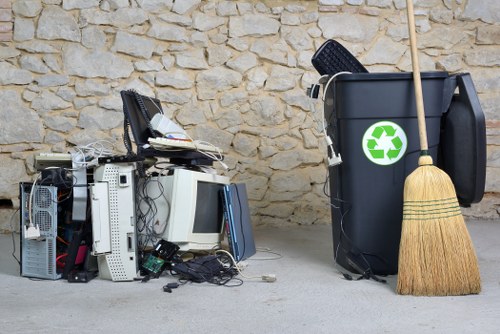
Items such as files and archived material may need to be separated from general office waste before removal, especially where the client wants a clear and tidy process. Likewise, older electronics and office devices can require their own route out of the property rather than being mixed into everyday rubbish. The exact handling depends on the mix of contents, but the principle remains the same: sort first, remove second, and keep the space manageable during the work. If you are handling a full floor or several rooms, that order matters even more.
Some customers also prefer to clear one area at a time, for example a filing room before the main office, or a storage area before a reception space. That can make the wider project easier to oversee and can reduce disruption for staff who still need to use part of the premises. A phased clearance does not need to be complicated; it simply needs a plan that matches the building and the contents rather than assuming all rooms should be treated in the same way.
About Hornsey
Hornsey is a district in north London within the London Borough of Haringey, known for its mix of Victorian and later urban development, busy local centres and strong transport links. The area sits between Crouch End, Wood Green and Finsbury Park, with residential streets, commercial stretches and community spaces all contributing to a varied urban character. Hornsey’s history stretches back to the medieval period, when it was recorded as a rural settlement outside London, and traces of its earlier development remain visible in the shape of some streets and older buildings. Hornsey High Street and the surrounding roads reflect layers of change, with independent shops, everyday services and surviving historic fabric standing alongside newer premises. The parish church of St Mary’s has long been one of the district’s notable landmarks, while the nearby New River adds another thread to the local landscape, linking the area to London’s water-supply history. Hornsey Town Hall, completed in the 1930s, is one of the best-known civic buildings in the district and is associated with interwar municipal architecture. Cultural life in the wider area also draws on neighbouring Crouch End and the borough’s theatres, schools and community venues, creating a setting that feels urban but still locally distinct. Parks and open spaces nearby, together with the railway corridor and major roads, shape how the district is experienced day to day. The result is a place with a strong sense of continuity: older structures and newer uses sit close together, and the district’s identity comes from that combination rather than from any single landmark alone.
Clearance for moves, refurbishments and end-of-tenancy work

Office clearance is often tied to a wider change in the building. A move to another site may leave behind desks, filing units or storage items that are not worth transporting. A refurbishment may require the space to be emptied before contractors can begin. An end-of-tenancy handover may need the premises left in a condition that allows the next stage to proceed without unnecessary delay. In each case, the clearance becomes part of the project timeline, so the work needs to be organised around that wider plan.
It is useful to think about the clearance in layers. First come the items that must stay, then the items that can be reused elsewhere, followed by the contents that need removal, sorting or disposal. This layered view is especially helpful when several people are involved in the decision-making. It keeps the work focused and helps avoid accidental removal of items that are still needed. For larger premises, a room-by-room approach can make the process easier to manage.
Useful ways to prepare for a quotation
If you want a quotation that reflects the real job, it helps to describe the property clearly, list the main contents, and note any access issues that could affect the work. Photos can be valuable when the space is crowded or when items are stacked in a way that makes them difficult to estimate from a short message. It is also sensible to mention whether the office is still in use, whether parking or loading access is available, and whether anything needs to be dismantled before removal. Those details help set expectations without turning the process into an administrative task.
Choosing the right scope for the job
Not every clearance needs to be handled in the same way. Some clients need one room emptied, while others need an entire office floor or a multi-room suite cleared in stages. The key is to match the scope to the actual contents and the condition of the site. A small but cluttered office can take as much planning as a larger, simpler one, because the main challenge may be sorting rather than volume. By contrast, a larger unit may be easier to organise if the contents are already grouped sensibly.
When choosing what to include, it helps to decide whether the job is mainly about furniture removal, mixed office contents, or a fuller clearance that also includes waste, storage and less obvious items. That decision affects the time needed, the number of loads, and the most suitable route through the building. If you are uncertain where to draw the line, start with the areas that cause the most obstruction and work outward from there. The aim is not to make the job sound bigger than it is, but to define it accurately enough to be completed properly.
Some businesses also want a clearer picture of how related services differ before they make contact. If that is useful, our office-clearance and pricing and quotes pages provide additional context. When you are ready to take the next step, please ask for a quotation and share the main details of the premises so the work can be assessed sensibly.
More than one way to clear an office

Some offices are cleared as a single project; others are cleared in parts. A phased job may start with storage rooms, continue with meeting spaces and finish with workstations and communal areas. That can be useful where staff still need access to part of the premises while the rest is being prepared for removal or handover. The important thing is to keep each stage coherent, so the items removed from one area do not simply create a new pile elsewhere. Good sequencing keeps the process controlled.
Where there are awkward or bulky items, the clearance may also need additional separation work before anything leaves the property. That can include taking apart large furniture, grouping mixed contents, or identifying pieces that should be kept apart because they are delicate, heavy or destined for different disposal routes. A careful method does not slow the job down unnecessarily; it prevents avoidable mistakes and helps the clearance finish in a cleaner, more organised state.
To discuss the scope in a practical way, use the main details of the office, the contents that need removing and any timing constraints that matter to you. If the job also involves household-style items, archive rooms or furniture that belongs in another category, mention that at the same time. Our flat clearance and house clearance pages show related clearance options, but for an office project in Hornsey the best next step is to request a quotation with the actual rooms and contents in mind.